- Fisheries technologist, Pacificus Biological Services Ltd.
- Company development manager, Carterms Donuterie
- GIS analyst, Partnership for Water Sustainability
- Coastal naturalist, BC Ferries & Parks Canada
- QA engineer, Safe Software
- Business development manager, Changeworks Recycling Ltd.
- Visitor services, Brooklyn Historical Society
Get a post-graduate work permit for up to three years if you are a full-time UBC international student graduating from a bachelor’s degree program and meet all eligibility criteria.
Want to learn more?
Visit the Faculty of Arts website to learn more about Geography: Environment and Sustainability.
View full program detailsProgram information
Gain an integrated understanding of physical, ecological, economic, socio-cultural, and political systems, as they shape the world in which we live and influence the future of life on planet earth. This program is suitable if you’re interested in working in the environmental sphere and will give you a strong platform for the development of a sense of global stewardship.
Program overview
- Campus
- Vancouver
- Program length
- 4 years
- Honours This option has additional requirements compared to those required in a Major specialization. Students must maintain high academic standing and may have to write a graduating thesis.
- No
- Co-op Co-op is an optional program where students alternate between academic terms and paid work terms. It’s an opportunity to gain relevant job experience while completing your degree.
- Yes
- Faculty
- Faculty of Arts
- Degree
- Bachelor of Arts
What you'll learn
Geography is about how things work together to make the world in which we live, and how we examine historical and contemporary events within cultural, physical, and social circumstances.
If you want a career in the environmental sphere, the Geography: Environment and Sustainability program will help you develop an understanding of global stewardship and establish a solid foundation of knowledge.
The Environment and Sustainability program is designed to be flexible and adaptable to suit your individual areas of curiosity and inquiry. Core courses in first, second, and third year, make it possible for you to join the program at your own pace. At every year level, and across each geographic sub-discipline, we encourage students to integrate methods, research, and learning from one course to another.As an undergraduate student, you are encouraged to engage in research, experiential learning, and other modes of involvement and engagement.
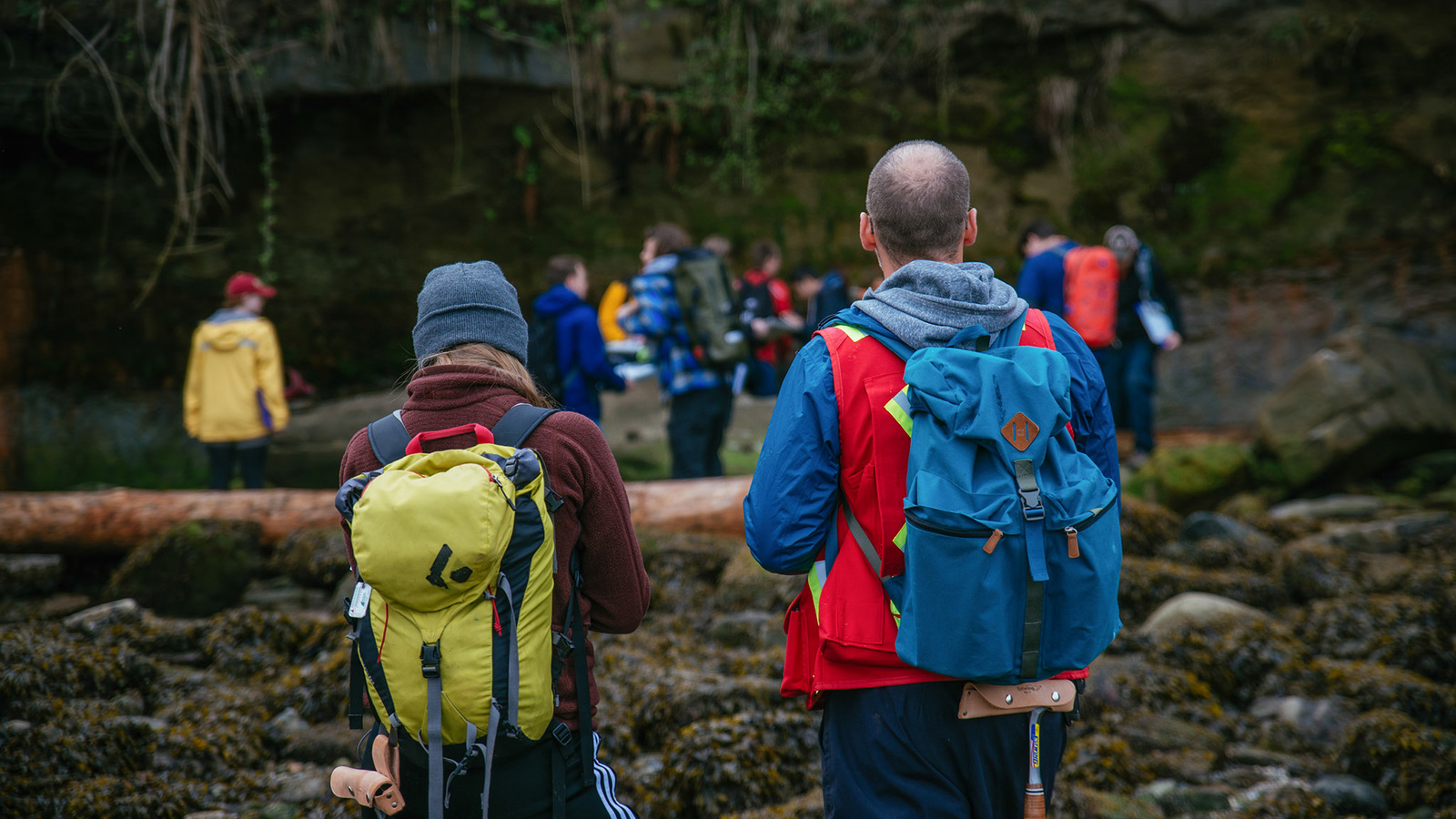
Some Geographical Sciences courses feature field trips, such as a week-long field research course held in May every year, or community development activities with various non-governmental organizations.
You can submit your work for publication in the journal Trail Six: an Undergraduate Journal of Geography, published by the Geography Students’ Association. Trail Six is peer-reviewed by UBC Geography faculty, and is a unique opportunity for you to get formal experience being published.
Many of our faculty have extensive relationships with organizations and individuals in our local communities, which can be jumping-off points for your own interests, investigations, and community-based learning.
Experiential learning and research
The Department of Geography is housed in the Geography Building, a hub for researching, teaching, learning, and community. The Geography Building includes multiple study spaces, an undergraduate lounge, and two state-of-the art geomatics computer labs, for you to work on Geography laboratory assignments and projects. The Department also houses the Geographic Information Centre (GIC), which is a library, reading room, and research space. Holdings include maps specializing in BC and Canada, atlases, books, and journals with geographical content, videos, course reserves, and BC’s largest aerial photo collection.
The Department of Geography also includes labs and research spaces in the Geography Building, around UBC, and beyond. The Geography building houses the Lab for Advanced Spatial Analytics, the Surfaces Processes Lab, and the Urban Studies Research Commons, to name a few. As an undergraduate student, you can experience these spaces through your Geography and Geographical Sciences coursework, or even through individual directed studies research projects with Geography faculty.
Experiential learning and research
As an undergraduate student, you are encouraged to engage in research, experiential learning, and other modes of involvement and engagement.
Some Geographical Sciences courses feature field trips, such as a week-long field research course held in May every year, or community development activities with various non-governmental organizations.
You can submit your work for publication in the journal Trail Six: an Undergraduate Journal of Geography, published by the Geography Students’ Association. Trail Six is peer-reviewed by UBC Geography faculty, and is a unique opportunity for you to get formal experience being published.
Many of our faculty have extensive relationships with organizations and individuals in our local communities, which can be jumping-off points for your own interests, investigations, and community-based learning.
Program advantages
As a Geography student, you will study in UBC’s Geography Department, which is consistently ranked in the top 10 Geography departments worldwide. You’ll have the opportunity to take newly redesigned courses developed by award-winning research and teaching faculty and join an inclusive, engaging, multidisciplinary academic community of 600+ undergraduate students, 100+ graduate students, and 30+ faculty.
Courses
There are hundreds of courses you can take within Geography: Environment and Sustainability. Here are a few you might like.
Energy and water in the Earth-Atmosphere system, global climates and climate change, ecosystem properties and processes, human impacts.
Physical principles underlying weather and climates. Thermal, moisture and wind climates from the scale of plants and animals to the globe. Daily weather systems and climate change.
Quaternary landscape development emphasizing the history of glaciation with special reference to western North America; applications of geomorphology in resource development and land management; interpretation of Quaternary materials. T
Geographical analysis of society-environment relations. Relates resource management to environmental politics, political economy, and sustainable development. Perspectives drawn from political ecology and political economy, environmental history and environmental philosophy.
Outcomes
The world needs smart, engaged new graduates to tackle complex environmental questions. Sustainability is an increasingly crucial concern in government, private practice, industry, higher education, community agencies, and beyond. The diverse, robust, and adaptable skills, knowledge, and training in the Environment and Sustainability program prepares you to investigate these questions across multiple contexts.
Program graduates
Take action & plan
Program requirements
Choose application type:
English-language requirements
English is the language of instruction at UBC. All prospective students must demonstrate English-language competency prior to admission. There are numerous ways to meet the English Language Admission Standard.
General admission requirements
IB Diploma Programme
- Completed IB Diploma, including at least three Higher Level courses.
IB Certificate Courses
- IB Certificate courses (Standard and Higher Level) may be used in an admissions average if you are graduating from a recognized high school curriculum that can be used as your basis of admission.
- IB Math Applications and Interpretations SL, or IB Math Studies, do not satisfy the math requirement for admission to UBC’s science-based programs, the Faculty of Management, the UBC Sauder School of Business, or the Vancouver School of Economics.
Degree-specific requirements: Arts
- No specific courses required beyond those needed for general admission
Related courses
The following subject categories are particularly relevant for this degree. Consider taking courses in these areas in your junior year and senior year.
- Language Arts
- Mathematics and Computation
- Second Languages
- Social Studies
- Visual and Performing Arts
Want to get a feel for campus?
If you’re unable to visit UBC in person, or you just want to get a sneak peek at your new home campus before you arrive, take one of our virtual tours. Current UBC students walk you through UBC’s residences, study spots, recreational facilities, lecture halls, academic buildings, and more.
Related programs
Want to learn more?
Visit the Faculty of Arts website to learn more about Geography: Environment and Sustainability.
View full program detailsGet a post-graduate work permit for up to three years if you are a full-time UBC international student graduating from a bachelor’s degree program and meet all eligibility criteria.
Want to learn more?
Visit the Faculty of Arts website to learn more about Geography: Environment and Sustainability.
View full program details