Get a post-graduate work permit for up to three years if you are a full-time UBC international student graduating from a bachelor’s degree program and meet all eligibility criteria.
Want to learn more?
Visit the School of Engineering website to learn more about Civil Engineering.
View full program detailsProgram information
In Civil Engineering, you’ll build a solid foundation, from the ground up – from soil mechanics and foundation engineering, to the design of structures, roads and transportation networks, river and flood management systems, construction management and law, environmental engineering (water and wastewater networks and treatment plants, air pollution, and waste management), and municipal engineering.
Program overview
- Campus
- Okanagan
- Program length
- 4 years
- Honours This option has additional requirements compared to those required in a Major specialization. Students must maintain high academic standing and may have to write a graduating thesis.
- No
- Co-op Co-op is an optional program where students alternate between academic terms and paid work terms. It’s an opportunity to gain relevant job experience while completing your degree.
- Yes
- Faculty
- School of Engineering
- Degree
- Bachelor of Applied Science (Engineering)
What you'll learn
Civil Engineering introduces you to the broad field of engineering that deals with the planning, construction, and maintenance of fixed structures and public works. Common civil engineering projects include buildings, plants, roads, water supply and sewer systems, and flood and traffic control. Civil engineers design structures and alter geography to suit human needs.
Specializations
- Environmental Engineering Concentration
- Resilient Infrastructure Management (RIM) Concentration
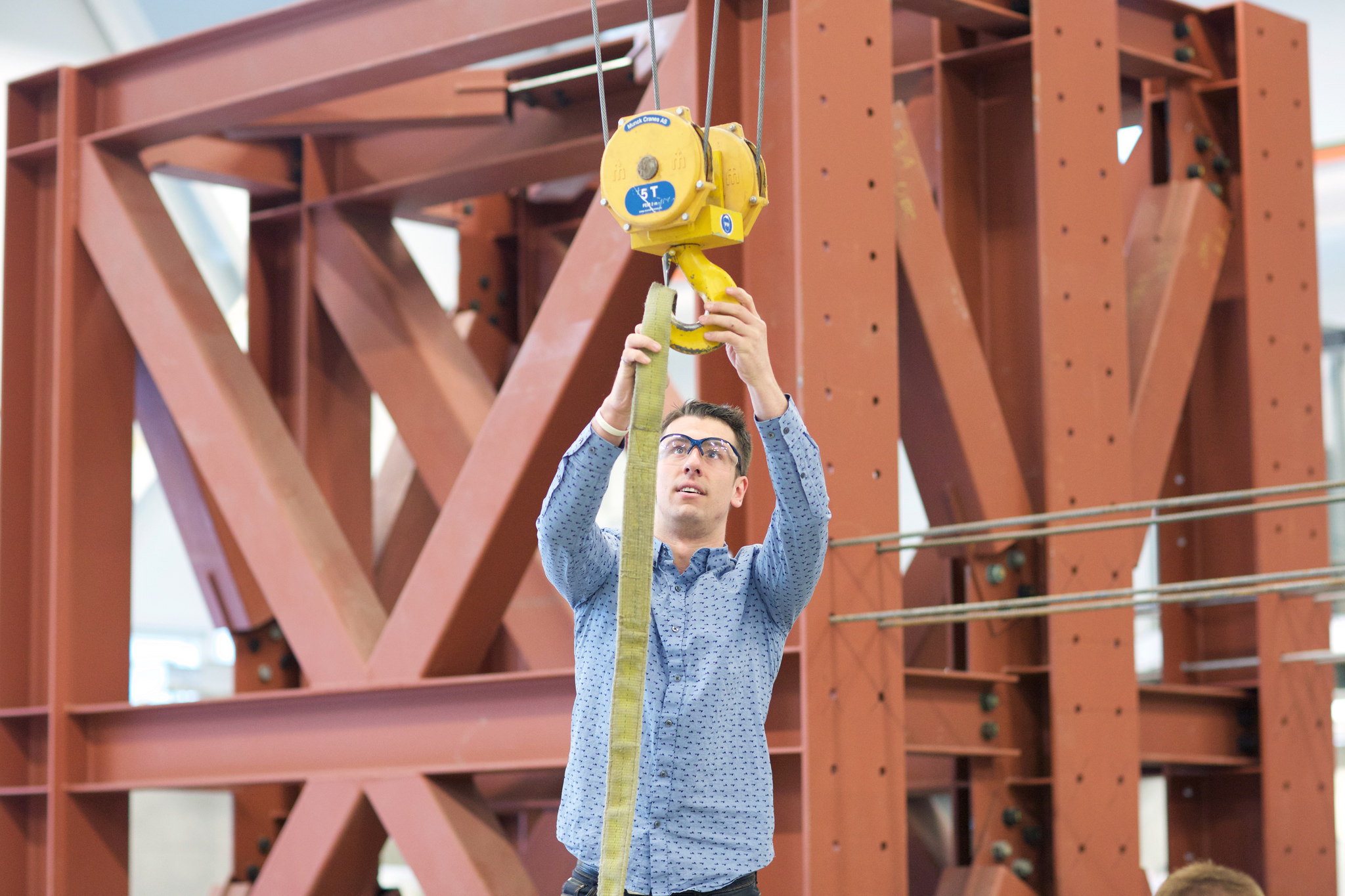
Consult with a School of Engineering Advisor about these Concentrations.The engineering program on UBC’s Okanagan campus has superb new facilities for teaching and research, which include undergraduate laboratories for civil engineering courses and research labs for biological solutions, life-cycle management, and for the creation, testing, and analysis of environmental and infrastructure projects.
Experiential learning and research
In fourth year you can complete the Engineering Capstone Design Project, where you design a project – which can be multidisciplinary or in a specialized area of engineering – in response to an actual engineering problem. You will then submit a comprehensive project report and deliver a formal presentation. Through Engineering Co-operative Education, you can work in BC, across Canada, or around the world while gaining international insight and developing technical skills, industry networks, and mentoring opportunities with professionals. As an engineering student, you can apply for a Natural Sciences and Engineering Research Council of Canada undergraduate student research award, and gain valuable work experience while working with a faculty member on one of their research projects.
From Women in Engineering to Engineers Without Borders to the Concrete Toboggan Club, UBC’s Okanagan campus has engineering-focused student clubs and associations that will help you meet your peers, have fun, and find opportunities for career growth in the process.
Campus features
The engineering program on UBC’s Okanagan campus has superb new facilities for teaching and research, which include undergraduate laboratories for civil engineering courses and research labs for biological solutions, life-cycle management, and for the creation, testing, and analysis of environmental and infrastructure projects.
Courses
There are hundreds of courses you can take within Civil Engineering. Here are a few you might like.
Theory and practice of sustainable engineering. Awareness and risk analysis of potential impacts on society and the environment over the lifecycle of engineering projects. Engineering design process, project lifecycle, and professional responsibility. Team-based design project
Data acquisition, sensors, instrumentation, measurement techniques and their limitations, experimental design, and data analysis; statistics, basic probability; application of statistics to data analysis.
Systems engineering, optimization, applied probability, and simulation for civil engineering infrastructure and the environment.
Strong ground motion, single-degree-of-freedom systems, earthquake response of linear and inelastic systems, subspace iteration, multi-degree-of-freedom systems, earthquake response and design, and building design consideration.
Take action & plan
Program requirements
Choose application type:
English-language requirements
English is the language of instruction at UBC. All prospective students must demonstrate English-language competency prior to admission. There are numerous ways to meet the English Language Admission Standard.
General admission requirements
IB Diploma Programme
- Completed IB Diploma, including at least three Higher Level courses.
IB Certificate Courses
- IB Certificate courses (Standard and Higher Level) may be used in an admissions average if you are graduating from a recognized high school curriculum that can be used as your basis of admission.
- IB Math Applications and Interpretations SL, or IB Math Studies, do not satisfy the math requirement for admission to UBC’s science-based programs, the Faculty of Management, the UBC Sauder School of Business, or the Vancouver School of Economics.
Degree-specific requirements: Applied Science (Engineering)
- IB Math Analysis and Approaches SL or HL, or IB Math Applications and Interpretations HL. (IB Math Applications and Interpretations SL, or IB Math Studies, are not acceptable.)
- IB Chemistry
- IB Physics
- Academically strong candidates missing either IB Chemistry or IB Physics may be evaluated on a case-by-case basis
Related courses
The following subject categories are particularly relevant for this degree. Consider taking courses in these areas in your junior year and senior year.
- Language Arts
- Mathematics and Computation
- Sciences
Want to get a feel for campus?
If you’re unable to visit UBC in person, or you just want to get a sneak peek at your new home campus before you arrive, take one of our virtual tours. Current UBC students walk you through UBC’s residences, study spots, recreational facilities, lecture halls, academic buildings, and more.
Related programs
Want to learn more?
Visit the School of Engineering website to learn more about Civil Engineering.
View full program detailsGet a post-graduate work permit for up to three years if you are a full-time UBC international student graduating from a bachelor’s degree program and meet all eligibility criteria.
Want to learn more?
Visit the School of Engineering website to learn more about Civil Engineering.
View full program details