- Data scientist, Foundation Medicine
- Lab analyst, ALS Environmental
- Senior editor and chocolate expert, Edible Vancouver & Wine Country Magazine
- Medical student, University of British Columbia
- Quality control laboratory technician, Viva Pharmaceutical Inc
- Post-Doctoral Fellow, BC Cancer Research Centre
- IB Chemistry teacher, New Westminster Secondary School
Get a post-graduate work permit for up to three years if you are a full-time UBC international student graduating from a bachelor’s degree program and meet all eligibility criteria.
Want to learn more?
Visit the Faculty of Science website to learn more about Chemistry.
View full program detailsProgram information
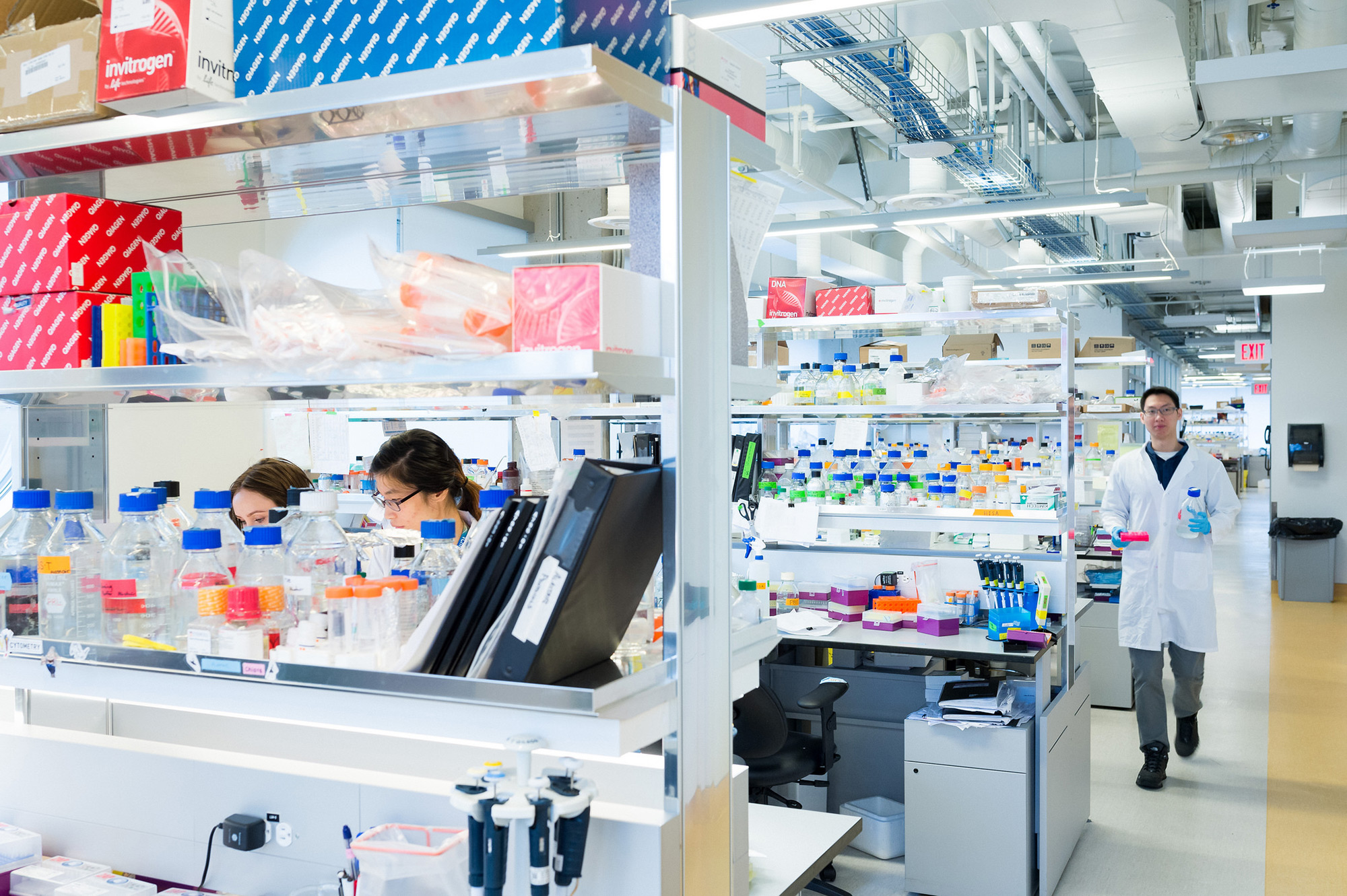
Chemistry is the science of the materials that make up our physical world, and comprises a diverse range of study, including areas such as pharmaceuticals, advanced materials, biochemistry, and theoretical chemistry. You’ll study matter and the changes that matter undergoes via physical and chemical processes, with the option to tailor your focus to a number of different sub-disciplines.
Program overview
- Campus
- Vancouver
- Program length
- 4 years
- Honours This option has additional requirements compared to those required in a Major specialization. Students must maintain high academic standing and may have to write a graduating thesis.
- Yes
- Co-op Co-op is an optional program where students alternate between academic terms and paid work terms. It’s an opportunity to gain relevant job experience while completing your degree.
- Yes
- Faculty
- Faculty of Science
- Degree
- Bachelor of Science
What you'll learn
Chemistry is a creative and imaginative science with many opportunities to make new discoveries, develop new molecules and materials, and increase our understanding of important processes. The foundational knowledge and skills obtained with a Chemistry degree give a solid foundation upon which to pursue a career directly related to this area. The deductive and deconstructionist thought process involved in solving chemical problems can also be used to address a wide range of issues. This means a Chemistry degree can be useful in non-traditional fields, and you may be surprised at the number of different ways chemistry combines with other disciplines.
The Chemistry specialization can be tailored to focus on a particular area of chemistry through careful elective selection. Areas of focus include biological, computational, environmental, theoretical, or materials chemistry. Combined Majors/Honours in Chemical Biology or Biochemistry and Chemistry are also options for students looking to improve their understanding of foundational chemical knowledge relevant for medical or dental school.
Experiential learning and research
The Department of Chemistry prioritizes undergraduate participation in research, offering several upper-level courses that allow students to obtain research experience. The UBC Chemistry Undergraduate Summer Research Awards provides opportunities for undergraduate students to further their interest in chemistry by conducting research in an academic environment.
Campus features
The UBC Chemistry Building, completed in 1925, is an important heritage site on campus. It has been featured in various film and television programs (X-Men, Supernatural, The X-Files, Psych, and more) because of its unique collegiate gothic architecture. The building was updated in 2008 as part of the UBC RENEW program, which worked to restore and maintain the building’s architectural integrity while updating its chemistry labs, lecture theatres, and administrative spaces.
The late UBC professor Michael Smith won the 1993 Nobel Prize in Chemistry for discovering how to make targeted genetic mutations in DNA. The new Michael Smith Building, housing the Biotechnology Laboratory, honours his legacy.
Program advantages
Study at one of Canada’s top Chemistry departments with internationally renowned professors. Enhance your professional development with Science Co-Op, summer research opportunities, and internships. Tailor the specialization with electives that reflect your interests or prepare you for graduate programs in chemistry, medicine, law, or journalism.
Courses
There are hundreds of courses you can take within Chemistry. Here are a few you might like.
Fundamentals of bonding theories and structural chemistry, with applications relevant to modern society.
Analytic geometry in 2 and 3 dimensions, partial and directional derivatives, chain rule, maxima and minima, second derivative test, Lagrange multipliers, multiple integrals with applications.
Application of mass spectrometry, and NMR, UV/visible, and IR spectroscopies to organic chemical problems.
Principles of experimental design, practice and problem solving in chemistry, including the opportunity to pursue projects in a research setting.
Outcomes
A BSc in Chemistry can lead to careers in research, medicine, dentistry, law, education, government, pharmacy, industry, or even food science.
Students graduate with strong critical thinking, communication, and research skills, which are highly sought after and are transferable to many workplaces.
Program graduates
Take action & plan
Program requirements
Choose application type:
English-language requirements
English is the language of instruction at UBC. All prospective students must demonstrate English-language competency prior to admission. There are numerous ways to meet the English Language Admission Standard.
General admission requirements
IB Diploma Programme
- Completed IB Diploma, including at least three Higher Level courses.
IB Certificate Courses
- IB Certificate courses (Standard and Higher Level) may be used in an admissions average if you are graduating from a recognized high school curriculum that can be used as your basis of admission.
- IB Math Applications and Interpretations SL, or IB Math Studies, do not satisfy the math requirement for admission to UBC’s science-based programs, the Faculty of Management, the UBC Sauder School of Business, or the Vancouver School of Economics.
Degree-specific requirements: Science
- IB Math Analysis and Approaches SL or HL, or IB Math Applications and Interpretations HL (IB Math Applications and Interpretations SL, or IB Math Studies, are not acceptable)
- One of IB Biology, IB Chemistry, or IB Physics
- Grade 11 or equivalent Chemistry, and
- Grade 11 or equivalent Physics (may be waived with grades of 5 in IB Chemistry and in your IB Mathematics course)
Note: Grade 11 Chemistry and Physics requirements listed are only relevant to students who are not completing the equivalent IB Diploma Chemistry and/or Physics courses.
For students studying outside of Canada, some examples of courses that may be accepted as Grade 11 equivalents are junior-level courses for American students, and IGCSE and O Level for those following British-patterned curricula.
Related courses
The following subject categories are particularly relevant for this degree. Consider taking courses in these areas in your junior year and senior year.
- Language Arts
- Mathematics and Computation
- Sciences
Want to get a feel for campus?
If you’re unable to visit UBC in person, or you just want to get a sneak peek at your new home campus before you arrive, take one of our virtual tours. Current UBC students walk you through UBC’s residences, study spots, recreational facilities, lecture halls, academic buildings, and more.
Related programs
Want to learn more?
Visit the Faculty of Science website to learn more about Chemistry.
View full program detailsGet a post-graduate work permit for up to three years if you are a full-time UBC international student graduating from a bachelor’s degree program and meet all eligibility criteria.
Want to learn more?
Visit the Faculty of Science website to learn more about Chemistry.
View full program details