Get a post-graduate work permit for up to three years if you are a full-time UBC international student graduating from a bachelor’s degree program and meet all eligibility criteria.
Want to learn more?
Visit the Irving K. Barber Faculty of Science website to learn more about Chemistry.
View full program detailsProgram information
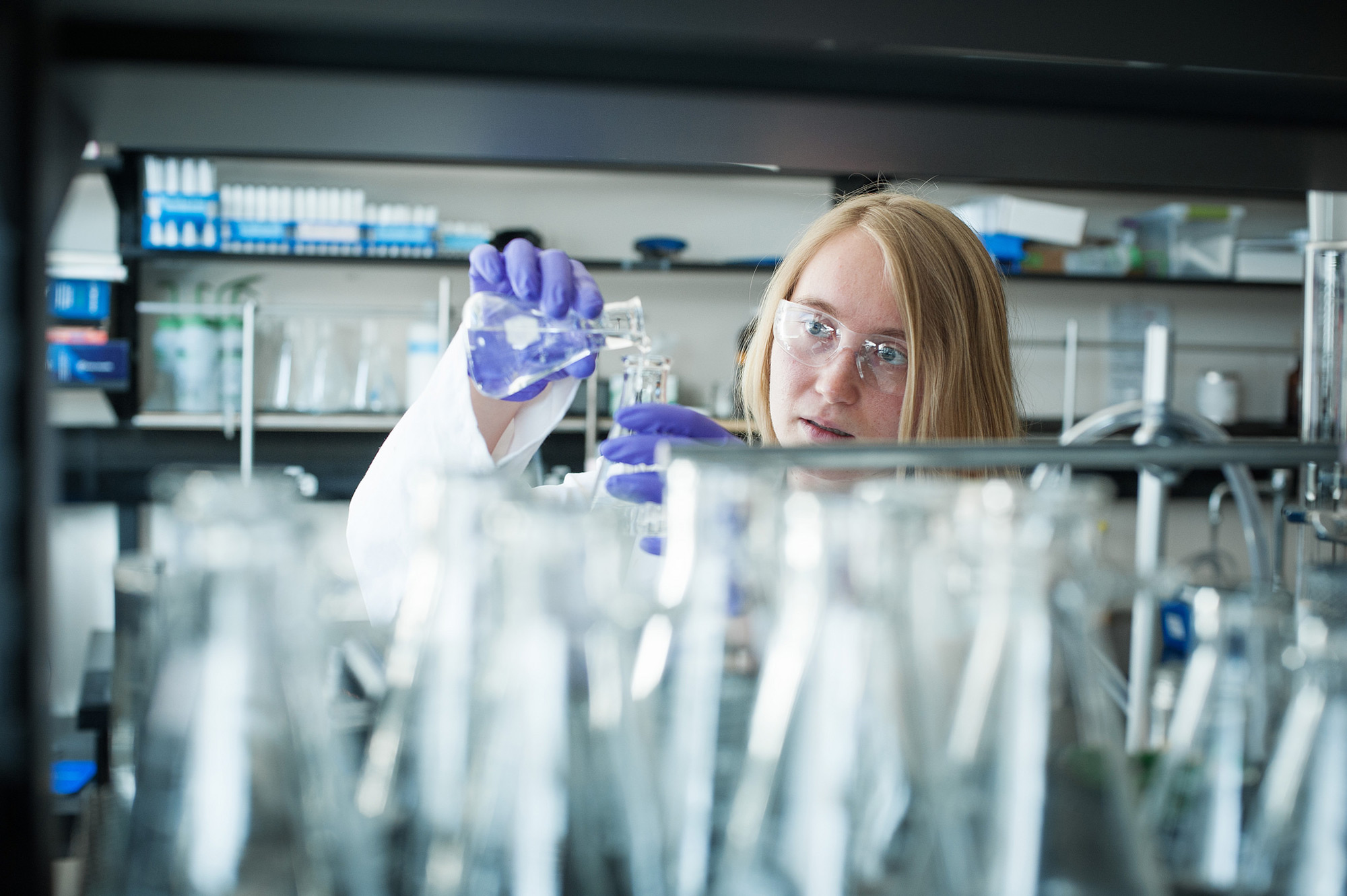
A Chemistry degree can open doors for careers in health-related professions, including medicine, and in a wide range of high-tech sectors. The Chemistry program includes a wide variety of foundational and advanced courses that cover atomic, molecular, physical, organic, environmental chemistry, and more.
Program overview
- Campus
- Okanagan
- Program length
- 4 years
- Honours This option has additional requirements compared to those required in a Major specialization. Students must maintain high academic standing and may have to write a graduating thesis.
- Yes
- Co-op Co-op is an optional program where students alternate between academic terms and paid work terms. It’s an opportunity to gain relevant job experience while completing your degree.
- Yes
- Faculty
- Irving K. Barber Faculty of Science
- Degree
- Bachelor of Science
What you'll learn
Get your UBC degree in Chemistry, and learn how to control matter. Chemistry can be used to make smart materials that can monitor your life signs, to analyze parts per trillion of environmental contaminants, and design nanostructured materials that can efficiently convert water into fuel. Chemistry can turn enzymes into microscopic industrial machines to produce life-saving pharmaceuticals or to eat up pollutants.
Your Chemistry degree can open doors to medical, dental, osteopathic, or veterinary school and many other careers in health-related professions. You can complete a Bachelor of Science (BSc) in Chemistry, a BSc honours in Chemistry, or a minor in Chemistry. You also have the opportunity to become an undergraduate research scholar with support through prestigious research awards.
Experiential learning and research
The Chemistry program’s summer employment opportunities give you real-world experience and the opportunity for a behind-the-scenes look at what UBC’s chemists do, like discovering physiologically active compounds in wine.
Directed Studies in Chemistry allow you to undertake independent research on a specific topic agreed upon by you and your faculty advisor. Or, you can pursue one of the many Undergraduate Research Awards available through the Irving K. Barber Faculty of Science.
The Chemistry Course Union on UBC’s Okanagan campus strives to bridge the gap between chemistry undergraduates, graduate students, and faculty, and will help develop your chemistry skills and build a network in the science community.
Campus features
Research facilities at the campus include the Fipke Lab for Trace Element Research, which houses several specialist analytical instruments.
The Department of Chemistry provides undergraduates access to a large variety of top-of-the-line analytical instruments that include mass spectrometry, gas and liquid chromatography, nuclear magnetic resonance and electron paramagnetic resonance spectroscopic techniques, optical microscopy, and high performance computational resources.
Program advantages
Work closely with peers and professors on the tight-knit Okanagan campus. Learn from the best: Chemistry professors are publishing their discoveries in top scientific journals. Get real world hands-on experience through the many research, co-op, or work study options available to undergrads.
Courses
There are hundreds of courses you can take within Chemistry. Here are a few you might like.
Introduction to mechanics primarily for students majoring in the physical sciences (e.g. physics, chemistry, mathematics, computer science, geology, physical geography) or engineering. Particle kinematics and dynamics, work and energy, momentum, gravitation, rigid body motion, fluid statics and dynamics with applications to the physical sciences.
Principles of chemical kinetics, reaction mechanisms, and chemical thermodynamics.
Properties of natural waters, including gas and solid equilibria, pH, redox, complexation analysis, corrosion treatment, ion exchange, colloids, and microbial transformations.
Enzyme kinetics: steady-state kinetic analyses, fast-reaction methods, kinetic isotope effects. Catalytic mechanisms: coenzymology, radical-mediated reactions, catalytic rate enhancements. Special topics: enzyme evolution, multifunctional enzymes, biocatalysis, protein engineering.
Outcomes
Career options include environmental chemist, food scientist, and professions in the pharmaceutical and health-care industries. People trained in chemistry become flexible thinkers who can solve problems and be successful in many different fields.
-
“In my research and lab experience I got to work closely with my professors, which immensely increased my knowledge on the subject at hand – it was a fantastic experience.”
Jeffrey K., Chemistry
Take action & plan
Program requirements
Choose application type:
English-language requirements
English is the language of instruction at UBC. All prospective students must demonstrate English-language competency prior to admission. There are numerous ways to meet the English Language Admission Standard.
General admission requirements
IB Diploma Programme
- Completed IB Diploma, including at least three Higher Level courses.
IB Certificate Courses
- IB Certificate courses (Standard and Higher Level) may be used in an admissions average if you are graduating from a recognized high school curriculum that can be used as your basis of admission.
- IB Math Applications and Interpretations SL, or IB Math Studies, do not satisfy the math requirement for admission to UBC’s science-based programs, the Faculty of Management, the UBC Sauder School of Business, or the Vancouver School of Economics.
Degree-specific requirements: Science
- IB Math Analysis and Approaches SL or HL, or IB Math Applications and Interpretations HL (IB Math Applications and Interpretations SL, or IB Math Studies, are not acceptable)
- One of IB Biology, IB Chemistry, or IB Physics
- Grade 11 or equivalent Chemistry
- Grade 11 or equivalent Physics is strongly recommended
Note: Grade 11 Chemistry and Physics requirements listed are only relevant to students who are not completing the equivalent IB Diploma Chemistry and/or Physics courses.
For students studying outside of Canada, some examples of courses that may be accepted as Grade 11 equivalents are junior-level courses for American students, and IGCSE and O Level for those following British-patterned curricula.
Related courses
The following subject categories are particularly relevant for this degree. Consider taking courses in these areas in your junior year and senior year.
- Language Arts
- Mathematics and Computation
- Sciences
Want to get a feel for campus?
If you’re unable to visit UBC in person, or you just want to get a sneak peek at your new home campus before you arrive, take one of our virtual tours. Current UBC students walk you through UBC’s residences, study spots, recreational facilities, lecture halls, academic buildings, and more.
Related programs
Want to learn more?
Visit the Irving K. Barber Faculty of Science website to learn more about Chemistry.
View full program detailsGet a post-graduate work permit for up to three years if you are a full-time UBC international student graduating from a bachelor’s degree program and meet all eligibility criteria.
Want to learn more?
Visit the Irving K. Barber Faculty of Science website to learn more about Chemistry.
View full program details