- Research analyst, Asia Pacific Foundation of Canada
- Sales Associate, Nishimoto Trading Co.
- Job developer, Neil Squire Society
- Coordinator/translator, Waterproof Studios
- Freelance Japanese-to-English translator
- Associate account strategist, Google
Get a post-graduate work permit for up to three years if you are a full-time UBC international student graduating from a bachelor’s degree program and meet all eligibility criteria.
Want to learn more?
Visit the Faculty of Arts website to learn more about Asian Area Studies.
View full program detailsProgram information
Gain a deeper understanding of Asian cultures while you study history, literary and religious traditions, languages, as well as gender relations. You’ll choose from diverse courses such as “Asian Horror Cinema: National Nightmares and Specters of Trauma,” “The Sikhs: History, Religion and Society,” and “Classical Hindu, Buddhist and Jain Myths and Legends in Translation.”
Program overview
- Campus
- Vancouver
- Program length
- 4 years
- Faculty
- Faculty of Arts
- Co-op Lorem ipsum dolor sit amet, consectetur adipiscing elit. Praesent congue purus nibh, vitae ultrices urna consectetur id. Aenean consequat condimentum auctor.
- Yes
- Degree
- Bachelor of Arts
- Honours Nunc posuere lacus felis. Proin libero turpis, aliquam nec laoreet non, congue a nibh. Quisque non tellus iaculis, bibendum magna vel, viverra felis.
- Yes
What you'll learn
Asian Studies uses multi- and inter-disciplinary approaches to study Asian societies and cultures, past and present. UBC’s Department of Asian Studies focuses on approaches to Asia based in the Humanities (language, literature, history, culture, religion, philosophy, gender studies, performance, visual culture) and features strong coverage of East Asia (China, Japan, Korea) and South and West Asia (India, Pakistan, and the Persianate world). It is one of the leading programs of its kind in the world. You can learn Mandarin Chinese, Classical Chinese, Japanese, Classical Japanese, Korean, Cantonese, Punjabi, Hindi-Urdu, Sanskrit, or Persian.
Graduates will value diversity and command a valuable and rare combination of Asia-relevant linguistic and inter-cultural competencies. Graduates become able to contribute to Canada’s evolving relationship with Asia in informed, original, and culturally appropriate ways.|Asian Studies majors are strongly urged to broaden and deepen their engagement with Asia by participating in a Go Global-sponsored study abroad experience, taking Asia-related courses in other Faculty of Arts departments, enrolling in the Arts Co-op and Internship Programs, as well as taking advantage of the many alumni, lecture, and other events sponsored by the department.|The Asian Library has the largest collection of Asian materials in Canada. Its holdings include the Puban collection of over 45,000 books and unpublished manuscripts and a serial collection of nearly 1,000 Chinese periodicals and newspapers. Among the library’s treasures is the oldest book in the UBC Library system, published in China in 986 AD. The collection also includes a 50,000-volume Indic languages collection with materials in Sanskrit, Hindi, Punjabi, Urdu, Bengali, Marathi, Tamil, and Gujarati.
Experiential learning and research
Asian Studies majors are strongly urged to broaden and deepen their engagement with Asia by participating in a Go Global-sponsored study abroad experience, taking Asia-related courses in other Faculty of Arts departments, enrolling in the Arts Co-op and Internship Programs, as well as taking advantage of the many alumni, lecture, and other events sponsored by the department.
Campus features
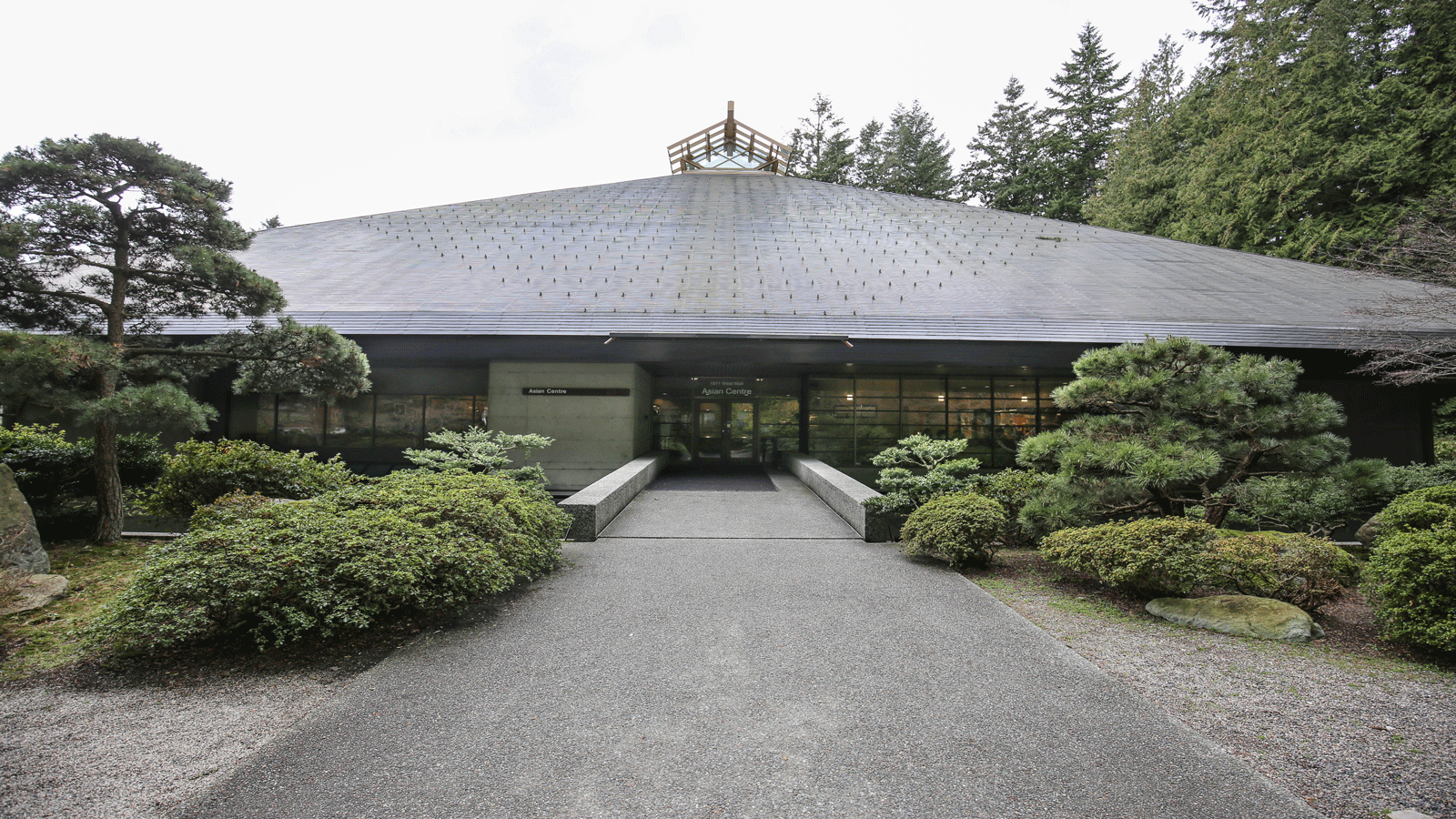
The Asian Library has the largest collection of Asian materials in Canada. Its holdings include the Puban collection of over 45,000 books and unpublished manuscripts and a serial collection of nearly 1,000 Chinese periodicals and newspapers. Among the library’s treasures is the oldest book in the UBC Library system, published in China in 986 AD. The collection also includes a 50,000-volume Indic languages collection with materials in Sanskrit, Hindi, Punjabi, Urdu, Bengali, Marathi, Tamil, and Gujarati.
Program advantages
Learn more about China, Canada’s second-largest trading partner, and India, which will soon make up almost half the world’s GDP and one-third of its population. Study at UBC’s Asian Library, which has the largest collection of Asian materials in Canada.
Most popular courses
A survey of the histories and cultures of Asia before 1600 and the coming of the Europeans. Emphasis will be given to parallel themes in the development of the civilizations of South, Southeast and East Asia
A survey of South Asian cultures, including language and literature, art, religion, polity and society, as they developed in the past and have been transformed in the modern period
History, contexts, and the genres of Korean popular music. Students will analyze specific artists and songs using a range of approaches. While an understanding of basic concepts of music will be helpful, no previous exposure to ethnomusicology or music performance is required
The mediation of folklore (e.g. slang, songs, games, dance, foodways) in the everyday lives of immigrant and transnational Asian communities. Emphasis on Asian-Canadian folklore in Greater Vancouver through digital documentary media production and archival folklore research.
Outcomes
As an Asian Studies graduate you will have a first-hand appreciation of linguistic and cultural difference, and a critically informed understanding of one or more cultures and civilizations of South or East Asia. These assets, along with strong research, writing, and critical thinking skills, set you up for other graduate and professional degrees; work in the Foreign Service, Canada Border Service Agency, and other branches of government; serve in NGOs and not-for-profit organizations; work as translators and interpreters in a variety of contexts; and employment in diverse educational, cultural, and media institutions.
Program graduates
-
“Each course that I took allowed me to expand and develop my capacities and eventually I became an expert in my field of research.”
Sarah Youngblutt, Anthropology and Asian Area Studies
Take action & plan
Program requirements
Choose application type:
English-language requirements
English is the language of instruction at UBC. All prospective students must demonstrate English-language competency prior to admission. There are numerous ways to meet the English Language Admission Standard.
General admission requirements
IB Diploma Programme
- Completed IB Diploma, including at least three Higher Level courses.
IB Certificate Courses
- IB Certificate courses (Standard and Higher Level) may be used in an admissions average if you are graduating from a recognized high school curriculum that can be used as your basis of admission.
- IB Math Applications and Interpretations SL, or IB Math Studies, do not satisfy the math requirement for admission to UBC’s science-based programs, the Faculty of Management, the UBC Sauder School of Business, or the Vancouver School of Economics.
Degree-specific requirements: Arts
- No specific courses required beyond those needed for general admission
Related courses
The following subject categories are particularly relevant for this degree. Consider taking courses in these areas in your junior year and senior year.
- Language Arts
- Mathematics and Computation
- Second Languages
- Social Studies
- Visual and Performing Arts
Want to get a feel for campus?
If you’re unable to visit UBC in person, or you just want to get a sneak peek at your new home campus before you arrive, take one of our virtual tours. Current UBC students walk you through UBC’s residences, study spots, recreational facilities, lecture halls, academic buildings, and more.
Related programs
Get a post-graduate work permit for up to three years if you are a full-time UBC international student graduating from a bachelor’s degree program and meet all eligibility criteria.
Want to learn more?
Visit the Faculty of Arts website to learn more about Asian Area Studies.
View full program details